
Most agencies take four to eight weeks to build a website. We take three to fifteen days. Here is the industry timeline stage by stage, what we do differently, and what actually makes projects slip.
One of the first questions every client asks is simple: how long does it take to build a website? There are really two answers — how long it takes across the industry, and how long it takes us. Both are worth knowing, because the gap between them is not magic, it is process. Below is the realistic industry timeline stage by stage, what we do differently, and the things that quietly add time to either.
How long does it take to build a website?
Across the industry, most business websites take four to eight weeks from kickoff to launch. A simple 3–5 page site is typically two to three weeks; a custom 15-page site with a blog and integrations six to eight; a full e-commerce store or web app eight to sixteen weeks. Those are honest figures for how most studios work, and if you are comparing quotes they are the numbers you should expect to hear. The biggest variable in every one of them is how fast content and feedback arrive.
How long it takes us
Our own timelines are shorter, and we quote them in writing before starting:
- Landing page — 3 to 5 days. A single page, mobile-first, with a working enquiry form and on-page SEO in place.
- Business website — 5 to 7 days. A full multi-page site with a CMS and SEO groundwork.
- E-commerce store — 10 to 15 days. Catalogue, payment gateway, inventory and order handling.
- Website redesign — 5 to 7 days, or 10 to 15 for a larger multi-page or e-commerce rebuild. A redesign is slower than an equivalent fresh build because auditing, migrating content and mapping redirects is real work a blank page does not require.
Those are days rather than weeks, which is a big enough claim that it deserves an explanation rather than an assertion.
Why the difference
- A small founder-led team with no handoff layers. Much of a four-to-eight-week schedule is not work, it is waiting — for an account manager to relay feedback, for a brief to reach a subcontractor, for your project to come up in someone's queue. We do not have those layers, so a decision made in the morning is usually built the same day.
- Custom code instead of fighting a page builder. A surprising share of agency time goes on bending a theme or builder into a shape it was never meant to take. Writing the markup directly is often faster than forcing a template to behave, and it leaves you with something lighter afterwards.
- Design approved before any code is written. You sign off a clickable design first. Rework after development has started is the single most expensive thing that can happen to a schedule, and approving the design up front removes most of it.
- Scope fixed in writing before we begin. Mid-project additions are the other classic schedule-killer. We quote a fixed scope, and anything new is priced and dated separately rather than absorbed silently.
What we cannot compress is your side of it. Our timelines assume content, logos and approvals arrive promptly. A five-to-seven-day build genuinely does stretch when copy is still being written in week two, or when feedback arrives in fragments from four people who disagree. That is not a disclaimer to get out of a deadline — it is the single biggest factor in whether any project, ours or anyone else's, lands on time.
What happens in each week of a typical project?
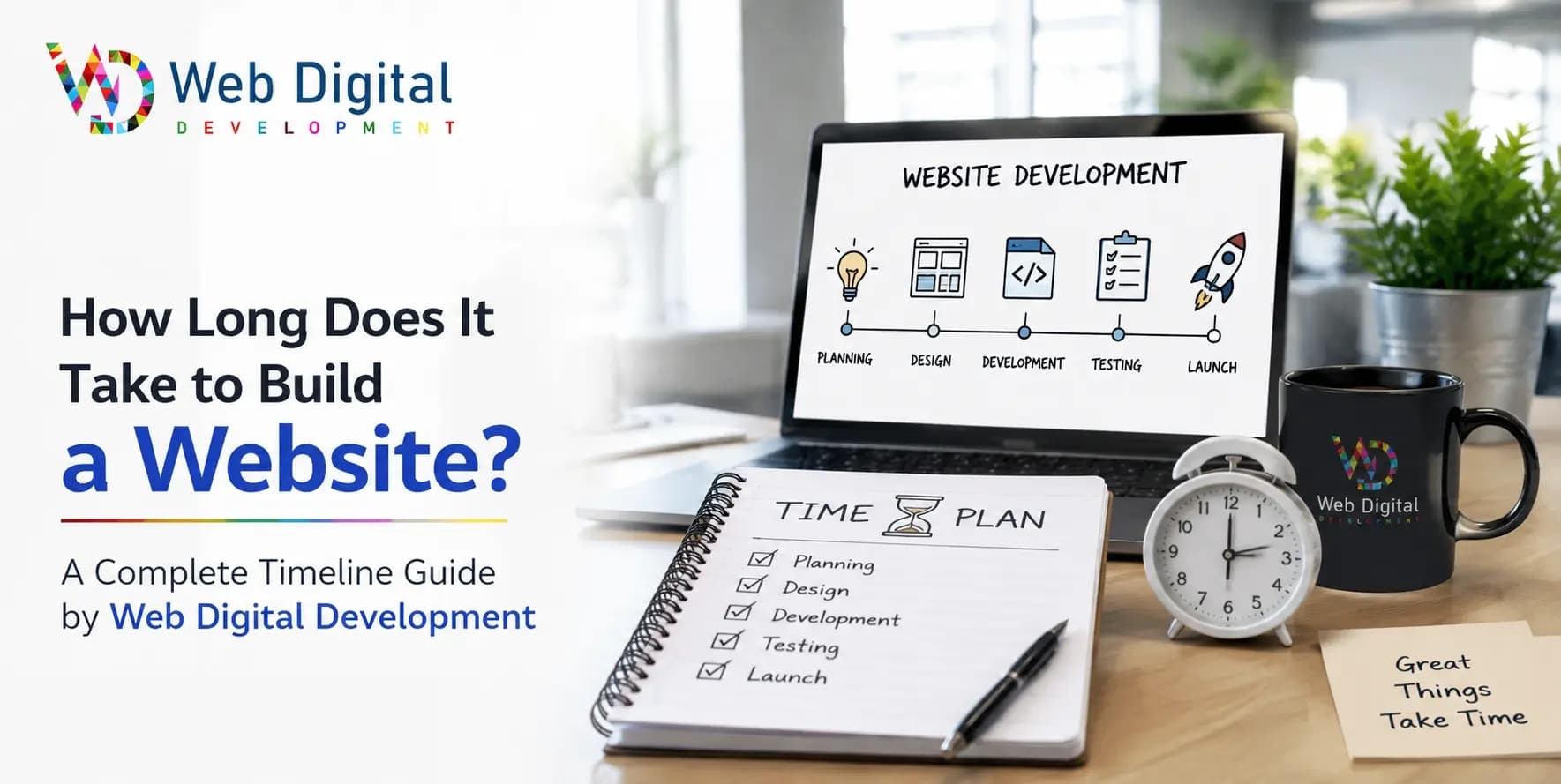
It is still worth understanding the stages, because the same work happens either way — the difference is how much waiting sits between them. Here is how the weeks usually fall on a standard custom business site built to the industry timeline.
- Week 1 — Discovery: goals, sitemap, references, content plan and a written scope.
- Weeks 2–3 — Design: wireframes, then a clickable design you approve before any code.
- Weeks 4–6 — Development: the approved design is hand-built, responsive and connected to your CMS.
- Week 6–7 — Content and SEO: copy, images, meta titles, schema and internal links go in.
- Week 7–8 — Testing and launch: cross-device checks, speed tuning, then go-live.
Our website development service runs through exactly these stages — discovery, design sign-off, build, content and SEO, testing, launch — compressed into days rather than weeks because nothing sits in a queue between them. Nothing is skipped to get there.
What slows a website project down?
Delays almost never come from coding — they come from waiting. The usual culprits are slow content delivery, late or contradictory feedback, scope added mid-project, and decision-makers who join only at the end. A site that should take a week can easily stretch into a month when copy and photos arrive piecemeal.
- Content not ready (text, logos, images, product details)
- Feedback that arrives slowly or changes direction each round
- New features requested after design is approved
- Waiting on third parties — payment approvals, domain access, hosting logins
- Too many reviewers with no single decision-maker
Can a website be built in a week?
Yes. For us a small site inside a week is normal rather than exceptional, provided the scope is tight, the content is ready and feedback is quick. What still cannot be rushed safely is a large custom build, an e-commerce checkout, or anything needing genuine testing across devices and browsers — which is why our e-commerce range is 10 to 15 days rather than a few. Speed comes from removing waiting, not from skipping testing.
How can I speed up my website build?
Decide who signs off before you start, gather your content and images upfront, and give consolidated feedback within a day of each milestone. Keep version one lean and add nice-to-haves after launch. The clients who launch fastest are simply the organised and decisive ones — not the ones who skip steps.
If you want a sense of how we work and who you would be dealing with, read more about our Delhi studio, or tell us your deadline and we will map a realistic timeline to it.
Can I launch in phases to hit a deadline?
Yes, and it is often the smartest move when a date is fixed. Launch a lean phase one with your core pages — home, services, about and contact — then add the blog, extra pages or advanced features in phase two. This gets you live on time without rushing the entire scope.
Phasing works because most of a site's value comes from a handful of key pages. Visitors need to understand what you offer and how to reach you; everything else can follow. It also spreads the cost and lets you learn from real visitors before building the rest. The key is planning the phases up front so the structure and design accommodate what is coming, rather than bolting things on awkwardly later. Agree which features are essential for launch and which can wait, and you can hit an aggressive deadline with a polished, smaller site instead of a late, half-finished large one.
Frequently asked questions
Why are your timelines so much shorter than the industry norm?
Because most of a multi-week schedule is waiting rather than working. We are a small founder-led team with no account-management layer and no subcontractors, we write custom code instead of wrestling a page builder, and we get the design approved before development starts so there is little rework. The stages are the same; the gaps between them are not.
How long does an e-commerce website take?
Across the industry, plan for eight to sixteen weeks. Ours run 10 to 15 days. Either way an online store needs product data entry, payment-gateway setup, shipping and tax configuration, and thorough checkout testing on top of design and development. Catalogue size and the number of integrations are what stretch it, so prepare your product information early.
Do I need all my content before we start?
Not all of it, but the more you have, the faster it goes — and on a five-to-seven-day build that matters far more than it does on a two-month one. We can design around placeholder content, but real copy and images must arrive before launch. Projects where content lands on day one almost always finish on time; those waiting on content almost always slip.
What is the fastest part of building a website?
Once the design is approved and content is ready, the actual development is usually the smoothest stretch. Clean, component-based code comes together quickly. The slow parts are the human ones — agreeing the design, writing the words, and getting timely sign-off from everyone involved.
Will rushing a launch hurt quality?
It can, which is why we compress the waiting rather than the testing. Skipping cross-device checks, speed tuning or SEO setup to hit a date means fixing problems live, in front of real visitors. If a deadline is genuinely fixed, launch a smaller, polished site on time and expand it afterwards.