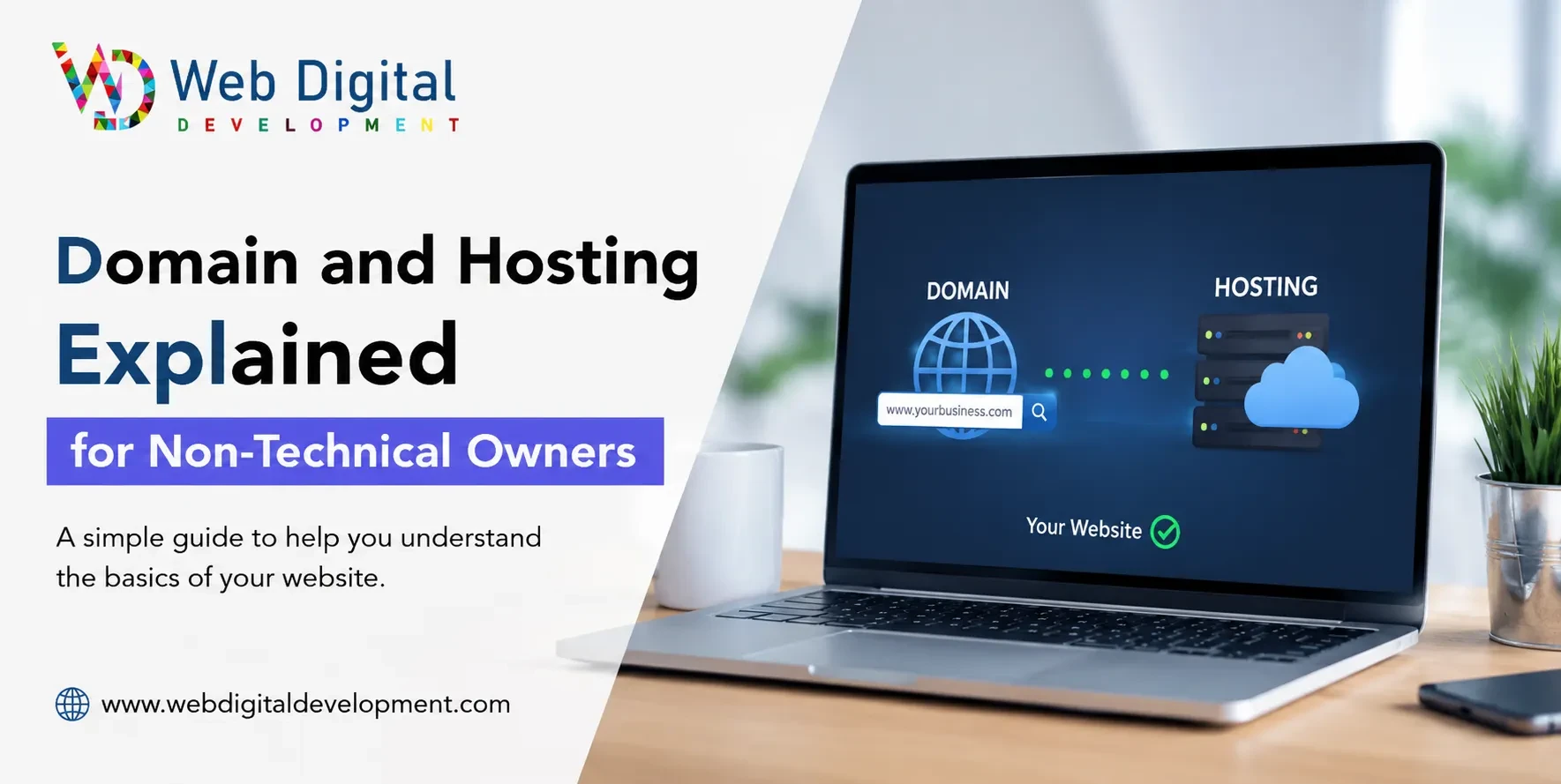
Domain and hosting explained in plain English — what each is, how they differ, .in vs .com, and what they should realistically cost per year in India.
Two words come up the moment you decide to build a website, and they confuse almost every non-technical owner: domain and hosting. Getting domain and hosting straight saves you money and stops you overpaying for things you do not need. This is the plain-English explanation — what each one is, how they differ, and what they should actually cost.
What is the difference between a domain and hosting?
A domain is your website's address (like yourbusiness.com); hosting is the space where your website's files actually live. The domain points visitors to the hosting. A useful analogy: the domain is your shop's street address, and hosting is the shop itself. You need both, and they are often bought separately.
Should I buy a .com or .in domain?
Use .com if you serve customers broadly or want the most recognised, trusted extension. Choose .in if your business is firmly India-focused and you want to signal that, or if your preferred .com is taken. Many businesses buy both and point one to the other. Neither meaningfully affects SEO on its own.
- .com — most recognised and trusted globally; usually the first choice.
- .in — clearly Indian; good for local brands or when .com is unavailable.
- Both — buy the pair and redirect one to protect your brand.
How much does hosting cost per year?
For a small business website, shared hosting runs roughly ₹1,500–6,000 a year, while better managed or cloud hosting costs more. A domain typically costs ₹800–1,500 a year. Avoid the cheapest overloaded plans — slow hosting hurts speed and SEO. Pay a little more for reliable hosting that keeps your site fast.
Who should own my domain and hosting accounts?
You should. Always register the domain and hosting in your own name, with your own email and payment details, even if a developer sets them up for you. If an agency owns them, you can be held hostage later. Owning these accounts means you control your website and can move providers freely.
Do I buy domain and hosting together or separately?
Either works. Buying them together from one provider is convenient and simple to manage. Buying separately gives flexibility — you can keep your domain at one registrar and host elsewhere, which makes switching hosts easier later. For beginners, one provider is simpler; just ensure both accounts are in your name.
If this still feels daunting, our website development service handles setup correctly and in your name, and you can always ask us a quick question before you buy anything.
What about business email on my domain?
Once you own a domain, you can have professional email addresses on it — like you@yourbusiness.com — instead of a generic Gmail or Yahoo address. Business email looks far more credible to customers and is usually inexpensive, either bundled with hosting or through services such as Google Workspace or Zoho Mail.
A professional, domain-based email is one of the cheapest credibility upgrades a business can make. Customers trust you@yourbusiness.com far more than yourbusiness123@gmail.com, and it keeps your branding consistent across your website and communication. Some hosting plans include basic email, but dedicated providers like Google Workspace or Zoho offer better reliability, storage and spam protection for a small monthly fee per user. Set it up as soon as your domain is registered so all your business correspondence uses it from day one. It is a small detail, but it quietly signals that you are an established, serious operation rather than a hobby — and that impression matters a great deal when a new customer is deciding whether to trust you with their money.
Frequently asked questions
Can I move my website to a different host later?
Yes. Websites can be migrated between hosts, and your domain can point to whichever host you choose. Keeping your domain and hosting in your own name makes this painless. If you ever outgrow a host or get poor service, you are free to move — you are not locked in.
Do I need to renew my domain every year?
Usually, yes — domains are registered annually, though you can pay for several years at once. Set auto-renewal or a reminder, because letting a domain expire can mean losing it to someone else and breaking your website and email. It is a small cost that is critical not to miss.
Is free hosting good enough for a business?
Generally no. Free hosting often adds ads, performs poorly, limits features and may not let you use your own domain properly. For a credible business website, modest paid hosting is well worth it. Free plans are fine for experiments, but not for a site customers and Google will judge.
Does my domain name affect SEO?
Only slightly. A clean, memorable, brandable domain helps users and trust, but stuffing keywords into a domain no longer boosts rankings meaningfully. Choose a name that is easy to say, spell and remember. Content, speed and authority matter far more for SEO than the exact words in your domain.